


Theory of Germ Disease
Louis Pasteur introduced techniques that are still used today. He made enormous contributions to our understanding of the microbial role in wine and beer formation. Pasteur invented the pasteurization and completed some of the first studies showing that human diseases could arise from infection. These studies, supported by the work of other scientists, became known as the germ theory of disease. Pasteur's contemporary, Robert Koch, established Koch's Postulates, a series of proofs that verified the germ theory and could establish whether an organism was pathogenic and which disease it caused.
Nowadays this is a simple idea and is generally accepted, it was no widely accepted when formulated in the mid-nineteenth century. People believe that broth, left standing, turned cloudy because of something about the broth itself. Even after it was shown that microorganisms, like the "worms" (maggots) in rotting meat, arose from nonliving things, a concept know as spontaneous generation. This belief hampered further development of the science of microbiology and the acceptance of the germ theory of disease.
The importance of microorganisms in disease was not immediately obvious to people, and it took many years to scientists to establish the connection between microorganisms and illness. Recognition of the role of microorganisms depended greatly upon development of new techniques for their study. Although Fracastoro and a few others had suggested that invisible organisms produced disease, most believe that disease was due to causes such as supernatural forces, poisonous vapors called miasmas, and imbalances between the four humors (blood, phlegm, yellow bile, and black bile) thought to be present in the body.
Support for the germ theory of disease began to accumulate in the early nineteenth century. Agostino Bassi first showed a microorganism could cause disease when he demonstrated in 1835 that silkworm disease was due to a fungal infection. He also suggested that many diseases were due to microbial infections. In 1845 M. J. Berkeley proved that the great Potato Blight of Ireland was caused by a fungus. Following his successes with the study of fermentation, Pasteur asked by the French government to investigate the pébrine disease of silkworms that was disrupting the silk industry. After several years of work, he showed that the disease was due to a protozoan parasite.
At the same time that abiogenesis was being hotly debated, a few physicians began tu suspect that microorganisms could cause not only spoilage and decay but also infectious diseases. It occurred to these rugged individualists that eve human body itself was a source of infection. Dr. Oliver Wendell Holmes, an American physician, observed that mother who gave birth at home experienced fewer infectious than did mothers who gave birth in the hospital; Dr. Ignaz Semmelweis of Austria showed quite clearly that women became infected in the maternity ward after examinations by physicians coming form the autopsy room.
English surgeon Joseph Lister took notice of these observations and developed a system of antiseptic surgery designed to prevent microorganisms from entering wounds. Instruments were sterilized, and phenol was used on surgical dressings and at times sprayed over the surgical area.
The first direct demonstration of the role of bacteria in causing disease came form Robert Koch and his study of anthrax. Koch used the criteria establish by Jacob Henle (his former teacher), to establish the relationship between Bacillius anthracis and anthrax, he injected healthy mice with the material from diseased animals, and the mice became ill. After transferring anthrax by inoculation through a series of 20 mice , he incubated a piece of spleen containing the anthrax bacilus in beef serum. The bacilli grew, reproduced, and produced spores. Koch's outstanding achievement was the formulation of four postulates to associate a particular organism with a specific disease. Koch´s Postulates, which provided scientists with a method of establishments the germ theory of disease, are as follow:
1.- The specific causative agent must be found in every case of the disease.
2.- The disease organism must be isolated in pure culture.
3.- Inoculation of a sample of the culture of sample of the culture into a healthy, susceptible animal must produce the same disease.
4.- The disease organism must be recovered from the inoculated animal.
Implied in Koch's postulates is his one organism-one disease concept. The postulates assume that infectious disease is cause by a single organism. This concept was also an important advance in the development of the germ theory of disease.
During Koch´s studies on bacterial diseases, it became necessary to isolate suspected pathogens. He tried to streaking bacterial suspensions on potato slices and then on solidified gelatin. But gelatin melts at incubator temperature; even at room temperature, some microbes liquefy it. Finally Angelina Hesse, the wife of Walther Hesse, one of Koch's asistants, suggested him to add agar as a solidifying agent to his bacteriological media. One of Koch's assistants, Richard Petri, developed the petri dish, a container for solid culture media. These developments made possible the isolation of pure cultures that contained only one type of bacterium, and directly stimulated progress in all areas of bacteriology.
 Agostino Bassi | 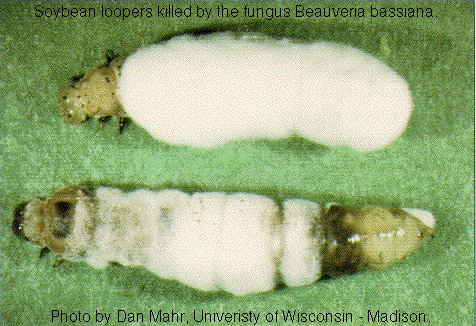 Soybeans killed by a fungus |
|---|---|
.png) M. J Berkley |  Potato blight |
 Dr. Holmes |  Dr. Holmes worked out how childbed fever was spread |
 Dr. Semmelweis |  Ignaz Semmelweis washing his hands in chlorinated lime water before operating. |
 Dr. Joseph Lister |  Carbolic acid solution, modification by Lucas-Championniere of Joseph Lister's invention. |
 Robert Koch |  Koch's postulates |
 Angelina Hesse |  Julius Richard Petri |
 L. Pasteur |  Silkworms with pébrine disease |
References:
-
Cowan, Marjorie Kelly. Microbiology: a systems approach. McGraw-Hill, 2012; New York.
-
Willey, Joanne M., Linda Sherwood, and Christopher J. Woolverton. Prescott's principles of microbiology. Boston (MA): McGraw-Hill Higher Education, 2009.
-
Black, Jacquelyn G., and Laura J. Black. Microbiology: principles and explorations. John Wiley & Sons, 2018.
© 2020 by The Microbiology Post. Proudly created with Wix.com